Gears don’t fail the way most prints fail. Instead of splitting neatly along a layer line, they wear down at the tooth surface, creep under load, soften with heat, or slowly lose accuracy as the filament absorbs moisture or shrinks.
This guide ranks practical filament options for printing gears and other mechanical parts. You’ll learn which materials tend to hold up best, what trade-offs to watch for, and when “easy to print” filaments (like PLA blends) are still a smart choice.
1. Nylon (PA6/PA12) for durable, low-friction gears

For many setups, the biggest win is reliability over time: nylon teeth are less likely to chip under repeated load than more brittle plastics.
If you want a nylon example that’s ready to consider for gears, OVERTRUE Nylon 1kg 1.75mm Gray is in the category you’d reach for when you need tougher mechanical performance.
Strengths
- Strong and impact-resistant teeth that can survive repeated meshing
- Often lower friction than PLA, which helps with wear
- Good fit for parts that need to tolerate real-world movement and vibration
Weaknesses
- Nylon is hygroscopic, so absorbed moisture can hurt surface finish and dimensional accuracy
- Warping risk and tendency to be less “forgiving” than PLA if your enclosure/bed setup isn’t solid
- Not ideal if the gear needs very crisp tolerances without careful dialing-in and post-processing
2. Polycarbonate (PC) for heat-resistant, high-load mechanical parts
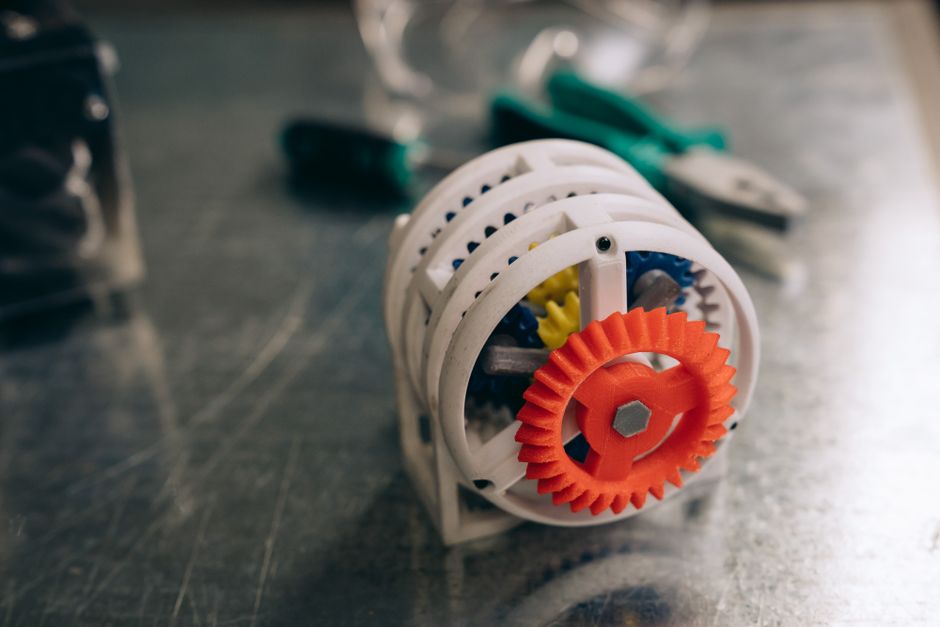
Compared to nylon, PC is often a better choice when heat is the main enemy. It’s also a strong candidate for non-gear mechanical components like housings and brackets where stiffness matters.
Strengths
- Better heat tolerance than many common hobby filaments
- Good mechanical toughness and rigidity for loaded parts
- Can hold shape well when printed and treated correctly
Weaknesses
- Higher difficulty: it typically benefits from a controlled environment (commonly an enclosure)
- More sensitive to print tuning than PLA for consistent dimensional results
- Can be harder to machine after printing due to toughness (you’ll want the right tools and plan tolerances)
3. Nylon blends and reinforced nylon (for wear and dimensional stability)
If you’re printing gears that experience noticeable tooth wear, consider nylon blends—especially variants that add lubricity or reinforcement. Reinforcements (commonly fibers) can increase stiffness and wear resistance, but they also change how the material shrinks and how it behaves between layers.
You don’t need to chase the most “advanced” blend first. The practical approach is choosing a nylon-style filament for toughness, then selecting a blend only when you know wear is your limiting factor.
Strengths
- Can improve wear behavior and stiffness compared to plain nylon
- Useful when gear performance depends on tooth shape staying crisp under load
Weaknesses
- Can be more demanding to print than basic nylon (tuning matters)
- Reinforcements may increase brittleness in some orientations and can make post-processing trickier
- Dimensional accuracy still depends heavily on moisture control and consistent cooling
4. PETG for a balanced “easy functional” option
PETG is often the best starting point for mechanical prints that must be tougher than PLA, but without the hassle of nylon or PC. For gears, it can work well for light to moderate loads—especially when you can reduce tooth stress through design.
PETG’s real advantage is practicality: it’s generally more straightforward to print than nylon/PC, so you can iterate on gear geometry faster.
Strengths
- Tougher than PLA and more impact-resistant than many commodity plastics
- Typically easier printing and fewer reliability issues than nylon/PC
- Good for brackets, couplers, and test gears while you dial in fit and backlash
Weaknesses
- Heat tolerance is often lower than PC; sustained warm operation can soften the teeth
- Can be more prone to creep than nylon/PC under continuous load
- Sliding wear can be higher than nylon if lubrication and surface finish aren’t right
5. ABS and ABS blends for toughness and manageable heat (with tuning)
ABS can perform well for mechanical parts when printed correctly. It’s less hygroscopic than nylon, and many ABS users get consistent results once the printer is dialed in.
For gears, ABS tends to be a reasonable option when you need a tougher plastic than PLA and still want something more printable than PC/nylon—while accepting that wear characteristics may not beat nylon.
Strengths
- Better heat and toughness than PLA in many real-use scenarios
- More stable than nylon against moisture-related surprises
Weaknesses
- Warping and layer stress management are important
- Still not ideal for high-wear gear teeth compared with nylon-like materials
- Dimensional accuracy can shift if cooling conditions aren’t consistent
6. PLA-CCT blends for light-duty gears and fast prototyping
PLA blends with modified formulations (including “CCT” style blends) can be surprisingly useful for gears that won’t see heavy load, high heat, or long service life. They’re popular because they print cleanly and can be dimensionally consistent on many printers.
For example, eSUN PLA CCT 3.00mm 0.5kg Blue fits into this category and is worth considering when you’re building test gears, covers, knobs, or low-stress mechanical parts where stiffness and surface detail matter more than toughness.
Strengths
- Easy printing and often good dimensional repeatability
- Clean tooth geometry for prototypes and low-wear applications
Weaknesses
- Lower impact resistance: teeth can chip under shock loads
- Heat tolerance is limited; gears may soften in warm environments
- Wear can accelerate quickly compared with nylon/PC, especially with dry sliding
Which filament should you choose for gears?
Rank-wise, a practical starting order for “real mechanical use” is:
- Nylon (1) when you want tough teeth and good wear behavior.
- Polycarbonate (2) when heat resistance and stiffness matter more than ease.
- Nylon blends/reinforced nylon (3) when wear is your limiting factor and you can tune for it.
- PETG (4) when you need a reliable, easier functional material for moderate loads.
- ABS (5) when you want toughness and manageable moisture behavior.
- PLA-CCT blends (6) when you need speed, clean geometry, and light-duty service.
If you’re not sure where you land, decide based on the dominant failure mode you expect:
- Tooth chipping under load or vibration → start with nylon.
- Softening in a warm environment → start with polycarbonate (or another higher-temperature plastic).
- Tooth wear over time (especially dry sliding) → look at nylon blends/reinforced nylon.
- You need quick iteration and consistent fits → PETG first.
- You’re testing geometry, making non-critical gears, or keeping things cool → PLA-CCT can be fine.
Whichever filament you choose, the one thing that most improves gear reliability is controlling how accurate the teeth are after printing. Dry hygroscopic filaments, print consistently, and plan for post-processing of bores (and, if needed, light surface finishing) so the gear seats properly and doesn’t force misalignment at the tooth contacts.
PriceIt3D may earn a commission when you buy through links on this page, at no extra cost to you. Affiliate notice.